Transfer Domain Names

  • Subscribe to our RSS feed.
  • Twitter
  • StumbleUpon
  • Reddit
  • Facebook
  • Digg

Tuesday, 16 October 2012

A new tool to disavow links

Posted on 13:43 by Unknown
Webmaster level: Advanced

Today we’re introducing a tool that enables you to disavow links to your site. If you’ve been notified of a manual spam action based on “unnatural links” pointing to your site, this tool can help you address the issue. If you haven’t gotten this notification, this tool generally isn’t something you need to worry about.

First, a quick refresher. Links are one of the most well-known signals we use to order search results. By looking at the links between pages, we can get a sense of which pages are reputable and important, and thus more likely to be relevant to our users. This is the basis of PageRank, which is one of more than 200 signals we rely on to determine rankings. Since PageRank is so well-known, it’s also a target for spammers, and we fight linkspam constantly with algorithms and by taking manual action.

If you’ve ever been caught up in linkspam, you may have seen a message in Webmaster Tools about “unnatural links” pointing to your site. We send you this message when we see evidence of paid links, link exchanges, or other link schemes that violate our quality guidelines. If you get this message, we recommend that you remove from the web as many spammy or low-quality links to your site as possible. This is the best approach because it addresses the problem at the root. By removing the bad links directly, you’re helping to prevent Google (and other search engines) from taking action again in the future. You’re also helping to protect your site’s image, since people will no longer find spammy links pointing to your site on the web and jump to conclusions about your website or business.

If you’ve done as much as you can to remove the problematic links, and there are still some links you just can’t seem to get down, that’s a good time to visit our new Disavow links page. When you arrive, you’ll first select your site.


You’ll then be prompted to upload a file containing the links you want to disavow.


The format is straightforward. All you need is a plain text file with one URL per line. An excerpt of a valid file might look like the following:

# Contacted owner of spamdomain1.com on 7/1/2012 to

# ask for link removal but got no response

domain:spamdomain1.com
# Owner of spamdomain2.com removed most links, but missed these
http://www.spamdomain2.com/contentA.html
http://www.spamdomain2.com/contentB.html
http://www.spamdomain2.com/contentC.html

In this example, lines that begin with a pound sign (#) are considered comments and Google ignores them. The “domain:” keyword indicates that you’d like to disavow links from all pages on a particular site (in this case, “spamdomain1.com”). You can also request to disavow links on specific pages (in this case, three individual pages on spamdomain2.com). We currently support one disavowal file per site and the file is shared among site owners in Webmaster Tools. If you want to update the file, you’ll need to download the existing file, modify it, and upload the new one. The file size limit is 2MB.

One great place to start looking for bad links is the “Links to Your Site” feature in Webmaster Tools. From the homepage, select the site you want, navigate to Traffic > Links to Your Site > Who links the most > More, then click one of the download buttons. This file lists pages that link to your site. If you click “Download latest links,” you’ll see dates as well. This can be a great place to start your investigation, but be sure you don’t upload the entire list of links to your site -- you don’t want to disavow all your links!

To learn more about the feature, check out our Help Center, and we’d welcome your comments and questions in our forum. You’ll also find a video about the tool and a quick Q&A below.


We would reiterate that we built this tool for advanced webmasters only. We don't recommend using this tool unless you are sure that you need to disavow some links to your site and you know exactly what you're doing.

Q: Will most sites need to use this tool?
A: No. The vast, vast majority of sites do not need to use this tool in any way. If you’re not sure what the tool does or whether you need to use it, you probably shouldn’t use it.

Q: If I disavow links, what exactly does that do? Does Google definitely ignore them?
A: This tool allows you to indicate to Google which links you would like to disavow, and Google will typically ignore those links. Much like with rel=”canonical”, this is a strong suggestion rather than a directive—Google reserves the right to trust our own judgment for corner cases, for example—but we will typically use that indication from you when we assess links.

Q: How soon after I upload a file will the links be ignored?
A: We need to recrawl and reindex the URLs you disavowed before your disavowals go into effect, which can take multiple weeks.

Q: Can this tool be used if I'm worried about "negative SEO"?
A: The primary purpose of this tool is to help clean up if you've hired a bad SEO or made mistakes in your own link-building. If you know of bad link-building done on your behalf (e.g., paid posts or paid links that pass PageRank), we recommend that you contact the sites that link to you and try to get links taken off the public web first. You’re also helping to protect your site’s image, since people will no longer find spammy links and jump to conclusions about your website or business. If, despite your best efforts, you're unable to get a few backlinks taken down, that's a good time to use the Disavow Links tool.

In general, Google works hard to prevent other webmasters from being able to harm your ranking. However, if you're worried that some backlinks might be affecting your site's reputation, you can use the Disavow Links tool to indicate to Google that those links should be ignored. Again, we build our algorithms with an eye to preventing negative SEO, so the vast majority of webmasters don't need to worry about negative SEO at all.

Q: I didn’t create many of the links I’m seeing. Do I still have to do the work to clean up these links?
A: Typically not. Google normally gives links appropriate weight, and under normal circumstances you don't need to give Google any additional information about your links. A typical use case for this tool is if you've done link building that violates our quality guidelines, Google has sent you a warning about unnatural links, and despite your best efforts there are some links that you still can't get taken down.

Q: I uploaded some good links. How can I undo uploading links by mistake?
A: To modify which links you would like to ignore, download the current file of disavowed links, change it to include only links you would like to ignore, and then re-upload the file. Please allow time for the new file to propagate through our crawling/indexing system, which can take several weeks.

Q: Should I create a links file as a preventative measure even if I haven’t gotten a notification about unnatural links to my site?
A: If your site was affected by the Penguin algorithm update and you believe it might be because you built spammy or low-quality links to your site, you may want to look at your site's backlinks and disavow links that are the result of link schemes that violate Google's guidelines.

Q: If I upload a file, do I still need to file a reconsideration request?
A: Yes, if you’ve received notice that you have a manual action on your site. The purpose of the Disavow Links tool is to tell Google which links you would like ignored. If you’ve received a message about a manual action on your site, you should clean things up as much as you can (which includes taking down any spammy links you have built on the web). Once you've gotten as many spammy links taken down from the web as possible, you can use the Disavow Links tool to indicate to Google which leftover links you weren't able to take down. Wait for some time to let the disavowed links make their way into our system. Finally, submit a reconsideration request so the manual webspam team can check whether your site is now within Google's quality guidelines, and if so, remove any manual actions from your site.

Q: Do I need to disavow links from example.com and example.co.uk if they're the same company?
A: Yes. If you want to disavow links from multiple domains, you'll need to add an entry for each domain.

Q: What about www.example.com vs. example.com (without the "www")?
A: Technically these are different URLs. The disavow links feature tries to be granular. If content that you want to disavow occurs on multiple URLs on a site, you should disavow each URL that has the link that you want to disavow. You can always disavow an entire domain, of course.

Q: Can I disavow something.example.com to ignore only links from that subdomain?
A: For the most part, yes. For most well-known freehosts (e.g. wordpress.com, blogspot.com, tumblr.com, and many others), disavowing "domain:something.example.com" will disavow links only from that subdomain. If a freehost is very new or rare, we may interpret this as a request to disavow all links from the entire domain. But if you list a subdomain, most of the time we will be able to ignore links only from that subdomain.


Posted by Jonathan Simon, Webmaster Trends Analyst
Read More
Posted in advanced, webmaster tools | No comments

Wednesday, 10 October 2012

Make the web faster with mod_pagespeed, now out of Beta

Posted on 10:01 by Unknown


If your page is on the web, speed matters. For developers and webmasters, making your page faster shouldn’t be a hassle, which is why we introduced mod_pagespeed in 2010. Since then the development team has been working to improve the functionality, quality and performance of this open-source Apache module that automatically optimizes web pages and their resources. Now, after almost two years and eighteen releases, we are announcing that we are taking off the Beta label.

We’re committed to working with the open-source community to continue evolving mod_pagespeed, including more, better and smarter optimizations and support for other web servers. Over 120,000 sites are already using mod_pagespeed to improve the performance of their web pages using the latest techniques and trends in optimization. The product is used worldwide by individual sites, and is also offered by hosting providers, such as DreamHost, Go Daddy and content delivery networks like EdgeCast. With the move out of beta we hope that even more sites will soon benefit from the web performance improvements offered through mod_pagespeed.

mod_pagespeed is a key part of our goal to help make the web faster for everyone. Users prefer faster sites and we have seen that faster pages lead to higher user engagement, conversions, and retention. In fact, page speed is one of the signals in search ranking and ad quality scores. Besides evangelizing for speed, we offer tools and technologies to help measure, quantify, and improve performance, such as Site Speed Reports in Google Analytics, PageSpeed Insights, and PageSpeed Optimization products. In fact, both mod_pagespeed and PageSpeed Service are based on our open-source PageSpeed Optimization Libraries project, and are important ways in which we help websites take advantage of the latest performance best practices.


To learn more about mod_pagespeed and how to incorporate it in your site, watch our recent Google Developers Live session or visit the mod_pagespeed product page.


Posted by Joshua Marantz and Ilya Grigorik, Google PageSpeed Team
Read More
Posted in advanced, general tips, performance | No comments

Wednesday, 3 October 2012

Rich snippets guidelines

Posted on 03:00 by Unknown
Webmaster level: All


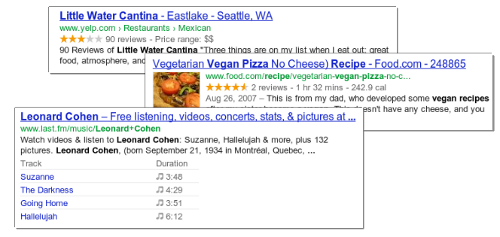
Traditional, text-only, search result snippets aim to summarize the content of a page in our search results. Rich snippets (shown above) allow webmasters to help us provide even better summaries using structured data markup that they can add to their pages. Today we're introducing a set of guidelines to help you implement high quality structured data markup for rich snippets.

Once you've correctly added structured data markup to you site, rich snippets are generated algorithmically based on that markup. If the markup on a page offers an accurate description of the page's content, is up-to-date, and is visible and easily discoverable on your page and by users, our algorithms are more likely to decide to show a rich snippet in Google’s search results.

Alternatively, if the rich snippets markup on a page is spammy, misleading, or otherwise abusive, our algorithms are much more likely to ignore the markup and render a text-only snippet. Keep in mind that, while rich snippets are generated algorithmically, we do reserve the right to take manual action (e.g., disable rich snippets for a specific site) in cases where we see actions that hurt the experience for our users.

To illustrate these guidelines with some examples:
  • If your page is about a band, make sure you mark up concerts being performed by that band, not by related bands or bands in the same town.
  • If you sell products through your site, make sure reviews on each page are about that page's product and not the store itself.
  • If your site provides song lyrics, make sure reviews are about the quality of the lyrics, not the quality of the song itself.
In addition to the general rich snippets quality guidelines we're publishing today, you'll find usage guidelines for specific types of rich snippets in our Help Center. As always, if you have any questions or feedback, please tell us in the Webmaster Help Forum.

Posted by Jeremy Lubin, Consumer Experience Specialist, & Pierre Far, Webmaster Trends Analyst
Read More
Posted in advanced, beginner, intermediate, search results, structured data, webmaster tools | No comments

Tuesday, 2 October 2012

Google Webmaster Guidelines updated

Posted on 10:26 by Unknown
Webmaster level: All

Today we’re happy to announce an updated version of our Webmaster Quality Guidelines. Both our basic quality guidelines and many of our more specific articles (like those on links schemes or hidden text) have been reorganized and expanded to provide you with more information about how to create quality websites for both users and Google.

The main message of our quality guidelines hasn’t changed: Focus on the user. However, we’ve added more guidance and examples of behavior that you should avoid in order to keep your site in good standing with Google’s search results. We’ve also added a set of quality and technical guidelines for rich snippets, as structured markup is becoming increasingly popular.

We hope these updated guidelines will give you a better understanding of how to create and maintain Google-friendly websites.

Posted by Betty Huang & Eric Kuan, Google Search Quality Team
Read More
Posted in advanced, beginner, intermediate, webmaster guidelines | No comments

Monday, 1 October 2012

Keeping you informed of critical website issues

Posted on 13:45 by Unknown
Webmaster level: All

Having a healthy and well-performing website is important, both to you as the webmaster and to your users. When we discover critical issues with a website, Webmaster Tools will now let you know by automatically sending an email with more information.

We’ll only notify you about issues that we think have significant impact on your site’s health or search performance and which have clear actions that you can take to address the issue. For example, we’ll email you if we detect malware on your site or see a significant increase in errors while crawling your site.

For most sites these kinds of issues will occur rarely. If your site does happen to have an issue, we cap the number of emails we send over a certain period of time to avoid flooding your inbox.  If you don’t want to receive any email from Webmaster Tools you can change your email delivery preferences.

We hope that you find this change a useful way to stay up-to-date on critical and important issues regarding your site’s health. If you have any questions, please let us know via our Webmaster Help Forum.

Posted by John Mueller, Webmaster Trends Analyst, Google Zürich
Read More
Posted in advanced, beginner, intermediate, webmaster tools | No comments
Newer Posts Older Posts Home
Subscribe to: Comments (Atom)

Popular Posts

  • Switching to the new website verification API
    Webmaster level: advanced Just over a year ago we introduced a new API for website verification for Google services. In the spirit of keepi...
  • Structured Data dashboard: new markup error reports for easier debugging
    Since we launched the Structured Data dashboard last year, it has quickly become one of the most popular features in Webmaster Tools. We’ve...
  • "It's on Google! YAY!" - Getting webmaster help in our forum
    Webmaster level: all It's been a bit more than five years now that our Webmaster Help Forum has been up and running, helping webmasters...
  • Supporting rel="canonical" HTTP Headers
    Webmaster level: Advanced Based on your feedback, we’re happy to announce that Google web search now supports link rel="canonical"...
  • Getting started with structured data
    Webmaster level: All If Google understands your website’s content in a structured way, we can present that content more accurately and more ...
  • Responsive design – harnessing the power of media queries
    Webmaster Level: Intermediate / Advanced We love data, and spend a lot of time monitoring the analytics on our websites. Any web developer d...
  • Introducing the Structured Data Dashboard
    Webmaster level: All Structured data is becoming an increasingly important part of the web ecosystem. Google makes use of structured data in...
  • Tell us what you think!
    (Cross-posted on the Google Product Ideas Blog ) The Webmaster Central team does our best to support the webmaster community via Webmaster T...
  • Improving URL removals on third-party sites
    Webmaster level: all Content on the Internet changes or disappears, and occasionally it's helpful to have search results for it updated ...
  • Protect your site from spammers with reCAPTCHA
    Webmaster Level: All If you allow users to publish content on your website, from leaving comments to creating user profiles , you’ll likely...

Categories

  • advanced
  • beginner
  • crawling and indexing
  • events
  • feedback and communication
  • general tips
  • hacked sites
  • hreflang
  • images
  • intermediate
  • localization
  • malware
  • mobile
  • performance
  • products and services
  • search results
  • sitemaps
  • structured data
  • url removals
  • verification
  • video
  • webmaster guidelines
  • webmaster tools

Blog Archive

  • ►  2014 (2)
    • ►  January (2)
  • ►  2013 (35)
    • ►  December (6)
    • ►  November (1)
    • ►  October (2)
    • ►  September (2)
    • ►  August (4)
    • ►  July (2)
    • ►  June (4)
    • ►  May (3)
    • ►  April (2)
    • ►  March (6)
    • ►  February (2)
    • ►  January (1)
  • ▼  2012 (55)
    • ►  December (3)
    • ►  November (1)
    • ▼  October (5)
      • A new tool to disavow links
      • Make the web faster with mod_pagespeed, now out of...
      • Rich snippets guidelines
      • Google Webmaster Guidelines updated
      • Keeping you informed of critical website issues
    • ►  September (2)
    • ►  August (5)
    • ►  July (5)
    • ►  June (6)
    • ►  May (7)
    • ►  April (7)
    • ►  March (6)
    • ►  February (2)
    • ►  January (6)
  • ►  2011 (75)
    • ►  December (7)
    • ►  November (2)
    • ►  October (5)
    • ►  September (8)
    • ►  August (10)
    • ►  July (5)
    • ►  June (10)
    • ►  May (8)
    • ►  April (6)
    • ►  March (6)
    • ►  February (5)
    • ►  January (3)
  • ►  2010 (81)
    • ►  December (9)
    • ►  November (9)
    • ►  October (4)
    • ►  September (8)
    • ►  August (6)
    • ►  July (2)
    • ►  June (6)
    • ►  May (6)
    • ►  April (12)
    • ►  March (11)
    • ►  February (1)
    • ►  January (7)
  • ►  2009 (52)
    • ►  December (7)
    • ►  November (9)
    • ►  October (13)
    • ►  September (8)
    • ►  August (6)
    • ►  July (5)
    • ►  June (4)
Powered by Blogger.

About Me

Unknown
View my complete profile